

U4Lead: A new innovative process for the desulphurization of lead paste
- Fusillo, R. Iannelli, F. Scura, G. La Sala, A.Bergamaschini - STC S.r.l. Lead Division, 72023 Mesagne (Italy)
An innovative patented process is presented for the desulphurization of lead paste from used lead-acid batteries (ULABs) recycling. The main characteristics are that the desulphurising agent is an amino compound and the process by-product is useful as fertilizer. High desulphurization yield (higher than 97%) is achieved using a very cheap reagent, safe for handling, storage and transportation: UREA. After several tests in our Laboratory, the process has been successfully tested on industrial scale in one of our ULAB recycling plants. The result and key figures are described below, along with a comparison with other desulphurization processes currently available on the market.
For a long time ULABs have been, and still are, the best available solutions for power supply with several
applications in many fields including automotive and energy storage, which are constantly growing markets.
One of the greatest strengths of lead acid battery recycling technologies lies in the possibility to recycle lead and its compounds almost entirely and infinitely: as matter of fact, today the world lead production from recycling (secondary lead) is higher than from mining operation (primary lead).
At present, pyrometallurgy represents the main approach to lead recycling from ULABs: the process, shown in figure 1, presents some issues mainly related to SO2 emissions and formation of slags (matte), that are normally considered hazardous waste.
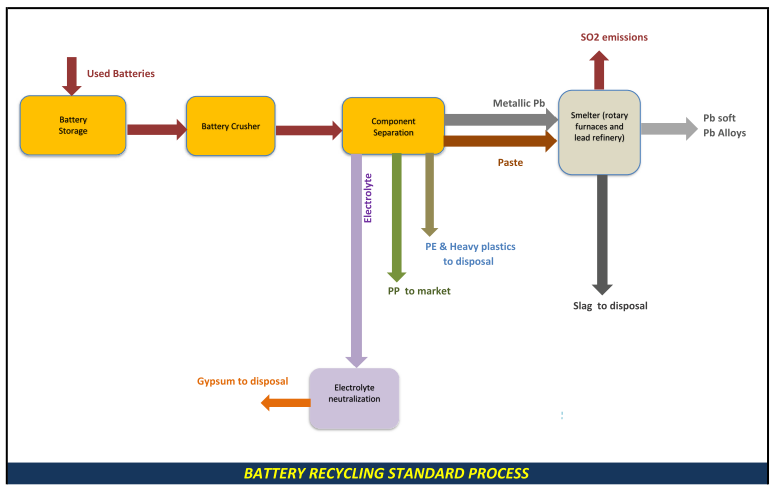
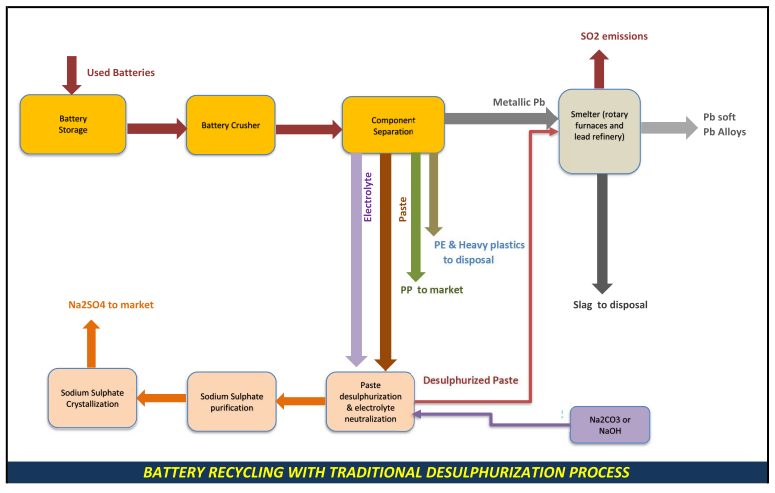
In order to reduce the environmental issues caused by the traditional pyrometallurgical process, cope with the pressure of local environmental authorities and with the costs increase for transportation and landfilling of hazardous waste, the hydrometallurgical desulphurization of the lead paste is widely used especially in Western Countries.
ADVANTAGES OF TRADITIONAL DESULPHURIZATION PROCESS
The main benefits resulting from the implementation of the paste desulphurization process in a battery recycling plant derive from a series of advantages concerning the following areas:
Process optimization
- Lower smelting temperature of desulphurised paste;
- Lower Sulphur in the desulphurised paste (typically 0,5-0,6%);
- Easier formation of iron-soda matte;
- Good quality of obtained slag;
- Easier refining operation (time reduction);
- Reduction of dross and ashes from refinery to be recycled.
Savings in production costs
- Reduction of slags generated (-65%) – hazardous waste to be transported and disposed of in special landfill sites at high cost;
- Less fluxants required and particularly iron consumption is reduced by 90%;
- Less fuel required (-15%);
- Less oxygen required (-15%) when using oxy-fuel burners;
- Higher productivity;
- Faster cycle;
- Smaller furnace;
- Less lead lost with slags;
- Revenue from sodium sulphate covers some of the additional costs (chemicals and energy).
Environmental impact reduction
- Drastic reduction of generated hazardous waste to be transported and disposed of in special landfill sites;
- Reduction of SO2 emissions -90%;
- Less fossil fuel consumption (oil or natural gas etc.);
- Less CO2 generated because of fuel consumption reduction;
- No liquid effluents as the process is Zero liquid discharge when crystallization is adopted: the condensate is reused inside the plant;
- No need for an external electrolyte neutralization system as the sulphuric acid can be converted into sodium sulphate in the same equipment used for paste desulphurization;
BASIS OF THE TRADITIONAL DESULPHURIZATION PROCESS
The chemistry of the traditional desulphurization is relatively simple and consists in the reaction between an alkali chemical (Na2CO3 or NaOH) and the lead sulphate (PbSO4) that is converted into Lead carbonate (PbCO3) or lead hydroxide Pb(OH)2.
The simplified overall reactions involved are the following:
PbSO4+Na2CO3-à PbCO3 + Na2SO4
PbSO4+2NaOHàPb(OH)2+ Na2SO4
The sodium sulphate solution Na2SO4 obtained as by product from the reaction, after a purification step (necessary to remove the contamination from heavy metals), can be crystallized to produce pure sodium sulphate that can be sold to detergent, glass, textile and paper industries.
The sulphuric acid contained in the electrolyte is also transformed into sodium sulphate according to the following reactions:
H2SO4+Na2CO3 à Na2SO4+H20+ CO2
H2SO4+NaOH à Na2SO4+H20
The equipment required for the desulphurization process consists of stirred reactors, pumps, chemical dosing system, filter press.
In few cases, depending on location and local authorities, the sodium sulphate solution, after purification step, can be directly discharged into the sea or reused in certain mining operations but generally the sodium sulphate solution is afterwards crystallized in a crystallization unit.
The system configuration is shown in figure 2.
There is a huge literature about the desulphurization process via (NH4)2CO3 but, to our knowledge, there are no existing operating plants on industrial scale employing ammonium carbonate to carry out the desulphurization reaction. Therefore, no real data are available for performance comparison.
The main disadvantages of using (NH4)2CO3 as chemical for the desulphurization reaction are the higher price of the chemical and the environmental consequences, pollution and safety issues related to production, transport, storage and handling of this compound. Due to the ammonium carbonate high volatility and subsequent NH3 released toxicity, procurement and transportation may become difficult specially because the production of ammonium carbonate is only concentrated in few countries (mainly China and India).
The possible onsite self-production of ammonium carbonate starting from Ammonia and CO2 has some drawbacks like high cost and safety problems related to ammonia transportation and storage.
PROBLEMS RELATED TO TRADITIONAL DESULPHURIZATION PROCESS
Beside the waste disposal problems, there are three other aspects to be considered:
- The demand for sodium sulphate, one of the main filler components used in washing powder production, with the advent of liquid detergents, has become weaker and consequently the sale price has slightly decreased although still presenting positive revenues.
- The quality of the chemicals, (especially when using sodium carbonate with chloride content) impose the use of special construction materials like AISI 904L or DUPLEX for heat exchanger and crystallizers in order to avoid the corrosion problems caused at high temperature in presence of chlorides.
- The cost of the chemicals (NaOH is a by-product of the chloro-alkali process and with the reduction of chlorine uses the cost of caustic soda in certain countries increased) sometimes makes the overall process more expensive.
STC IMPROVEMENTS THROUGH U4Lead PROCESS
STC has developed and patented an innovative desulphurization process in order to overcome the problems of the chemicals cost/quality and the relatively poor market for sodium sulphate, ensuring at the same time all the advantages of the desulphurization process.
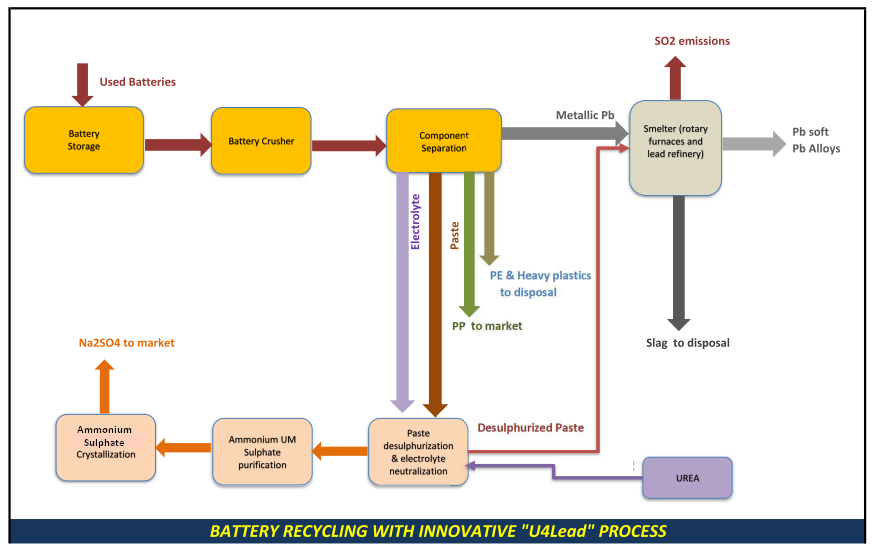
The U4Lead process by STC uses an amino compound, namely Urea, as chemical for the desulphurization of paste and electrolyte neutralization process.
The simplified reaction can be summarized as follows:
CO(NH2)2 + PbSO4+H2O à PbCO3 + (NH4)2SO4
CO(NH2)2 + H2SO4 + H2O à (NH4)2SO4+CO2
As by product, pure Ammonium Sulphate is obtained: this chemical has a very good market and can be sold, in liquid form or in crystals as fertilizer for agriculture.
STC can provide either full crystallization system to produce pure ammonium sulphate crystals or just an evaporation system in order to produce a concentrated solution of ammonium sulphate “ready-to-use”. The graphic of the process is represented in figure 3.
ADVANTAGES OF THE U4Lead PROCESS by STC
All the advantages of the traditional desulphurization are maintained and in many cases furtherly improved and in particular:
- A higher degree of conversion of the lead sulphate into lead carbonate, more than 97%, is achieved;
- The process is faster than using other chemicals thus allowing reduction of reactors volume;
- The desulphurization level obtained is higher than the traditional process (0,2-0,3% of Sulphur remaining)
- Further reduction of slag generation (only 5-6% on Pb produced!) and associated lead losses are achieved,
- Further reduction of Iron usage in the charge,
- Further reduction of fuel and oxygen consumption,
- Using UREA, there are no undesired side-reactions during desulphurization such as formation of double salts;
- UREA is normally cheaper than other reagents and is worldwide largely available;
- The by-product obtained is ammonium sulphate that could be used and sold easily as fertilizer in liquid or crystals form: the selling price is normally higher than sodium sulphate.
- UREA does not involve any environmental, pollution and safety problems for workers related to transport, storage and handling.
COMPARATIVE DESULPHURIZATION DESIGN OPTIONS
The three desulphurization design options are compared in the table below: (the data are partially empirical based on the practice and experience and therefore unrelated to scientific rigor)
|
Data Referred to 1 ton of SLI batteries treated full of electrolyte (15% of H2SO4) with a total average Pb recovery of 56%. |
No desulphurization* |
Desulphurization with Na2CO3 |
Desulphurization with NaOH |
Desulphurization with U4Lead Process by STC |
|---|---|---|---|---|
|
Paste characteristics |
|
|
|
|
|
Insoluble Sulphur % |
6,2% |
0,5% |
0,5% |
0,3% |
|
Na content |
-- |
2,5% |
2,5% |
-- |
|
NH4 content |
-- |
-- |
-- |
0,3% |
|
|
|
|
|
|
|
Chemicals consumption |
|
|
|
|
|
Na2CO3 kg/t |
-- |
130 |
-- |
-- |
|
NaOH kg/t (100%) |
-- |
-- |
100 |
-- |
|
(NH2)2CO |
-- |
-- |
-- |
75 |
|
|
|
|
|
|
|
By Products production |
|
|
|
|
|
Na2SO4 kg/t |
-- |
150 |
150 |
-- |
|
(NH4)2SO4 kg/t |
-- |
-- |
-- |
145 |
|
|
|
|
|
|
|
Smelting parameters and Chemicals for paste smelting (soda slag) |
|
|
|
|
|
Iron kg/t |
50 |
10 |
10 |
5 |
|
Coal kg/t |
20 |
20 |
20 |
20 |
|
Soda ash kg/t |
20 |
15 |
15 |
10 |
|
Batch time h |
6 |
5,5 |
5,5 |
5 |
|
Fuel consumption (CH4) Nm3/t |
45 |
37 |
37 |
34 |
|
Oxygen consumption Nm3/t |
90 |
74 |
74 |
68 |
|
|
|
|
|
|
|
Environment impact |
|
|
|
|
|
Typical SO2 concentration at stack mg/Nm3 |
600-800 |
100 |
100 |
80 |
|
Slag generated |
ab.17% |
Ab.7% |
Ab.7% |
Ab.3,5% |
|
Pb losses with slag (5%) |
0,85% |
0,35% |
0,35% |
0,18% |
|
|
|
|
|
|
|
Impact at refinery |
|
|
|
|
|
Drosses/ashes to be recycled |
5% |
3,5% |
3,5% |
3% |
|
|
|
|
|
|
*When no desulphurization process is adopted the recycling plant needs a dedicated section for the neutralization of the sulphuric acid contained in the electrolyte that here is not considered. In the desulphurization cases, the electrolyte treatment is integral part of the process and is neutralized together with the paste in the same equipment.
CONCLUSIONS
Hazardous waste and disposal costs are increasing all around the world and permitted emission levels are under continuous revision by Environmental Authorities;
Paste desulphurization allows smelting process optimization, cost reduction and better metallurgical results: these benefits are amplified using U4Lead by STC desulphurization process
Smelting desulphurised paste improves the overall environmental performances specially because of minimization of hazardous waste production and SO2 emissions;
The process U4Lead by STC, after the first initial tuning at the industrial plant, confirmed the excellent results already obtained in the lab scale testing;
The possibility to desulphurize the lead paste via UREA is verified for the first time on industrial scale in the World;
The process can be easily implemented and integrated into existing plants.
While from the environmental and process point of view the desulphurization process is always convenient, the real impact on production costs is more evident where the cost of disposal of the slag is high or when the availability of landfill for hazardous waste is limited. Therefore, the real economic advantages of the process have to be verified case by case and calculated carefully for each specific situation.
STC has developed a model for calculation of the process feasibility and return of the investment that is available for STC’s Customers.
STC is able to provide all kinds of desulphurization systems here described in this article, using all the chemicals available on local market, coupled with different kind of evaporation and crystallization systems including direct steam, cold and hot crystallizers, Mechanical Vapour Recompression, Heat Pump.